
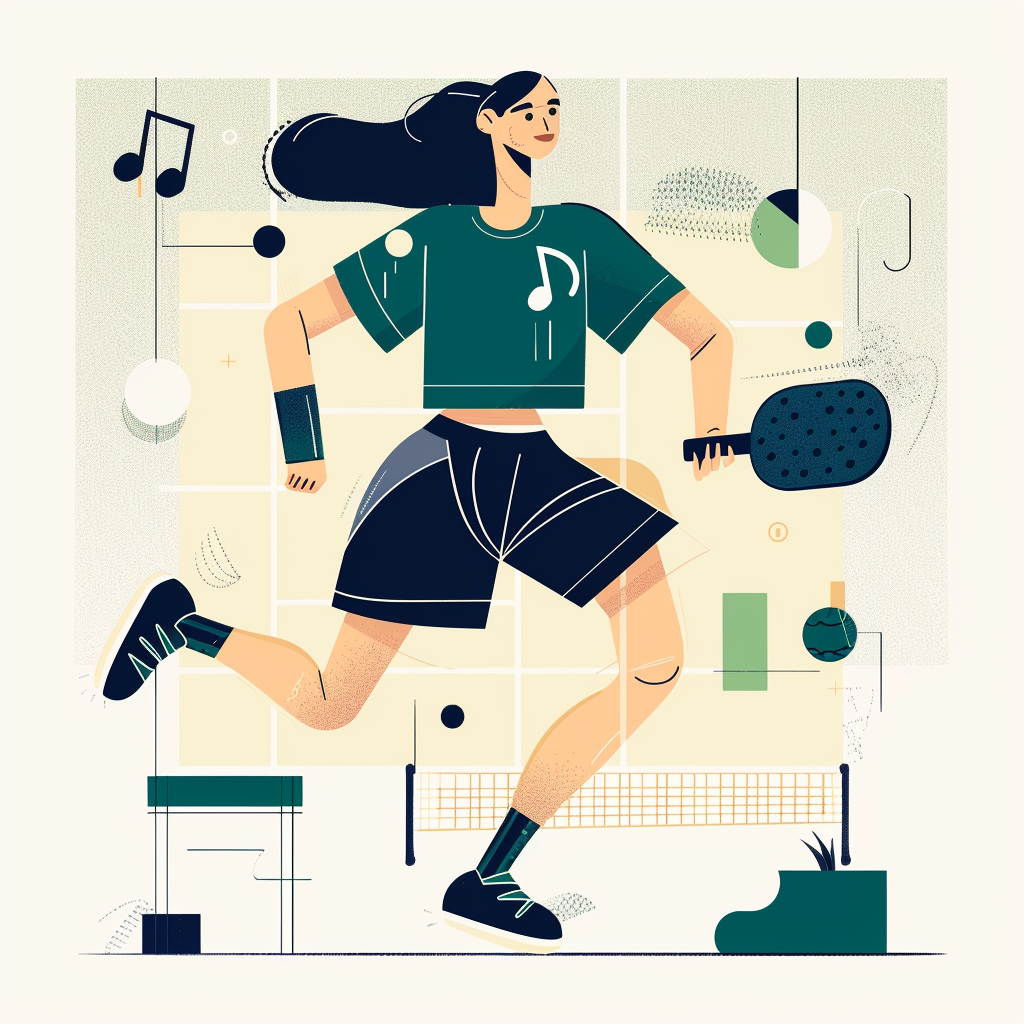
Post 6 of 9 in the Dink Deeper Type Profile Series
The rally has been going for twelve shots. Both teams are locked in — patient, precise, nobody blinking. And then something shifts. Not a tactical decision exactly. More like an instinct. Your partner reads the moment a half-second before anyone else does, rolls a ball down the line at an angle nobody expected, and the point is over.
Afterward they don’t say anything. They just walk back to position, already somewhere else in their head.
You want to ask what they saw. But you also kind of know you won’t fully get the answer.
This is what it’s like to share a court with a Type 4 — The Artist — when things are clicking. The creativity is real. The court sense is real. And the inner world driving all of it is deeper than most people around them realize.
So, Who Is The Artist?
The Artist is driven by something most players never consciously examine: the need for what they do to mean something. Not to win, not to look good — but for the experience on the court to feel authentic, connected, and somehow significant. When pickleball delivers that, they are fully present in a way that’s almost electric. When it doesn’t, no rating level or competitive stakes can hold their attention.
What drives them: Authentic expression. They want their game to feel like them — not a copy of a technique they’ve been taught, not a performance for anyone watching, but a real extension of how they experience the world.
What they’re quietly afraid of: Being ordinary. Being just another player running the same patterns as everyone else, partnered with someone who doesn’t really see them. The fear of being fundamentally misunderstood runs deeper than most people guess.
Their pattern on the court: Intuitive, expressive, capable of brilliance — and mood-dependent in ways that can be confusing to partners who expect consistency as a baseline.
In everyday life, you probably recognize the Artist as the person who:
- Brings a distinctive style to everything they do, including how they play
- Has a rich inner life that doesn’t always make it to the surface in conversation
- Feels things more intensely than they show — both the highs and the lows
- Is drawn to genuine connection and disengaged by anything that feels performative or hollow
- Can be hard to read, but deeply loyal once a real relationship is established
The Artist on the Pickleball Court
Pickleball has a soft game — a rhythmic, almost musical quality to a good dinking rally — and Artists often fall in love with this before they’ve developed the technique to consistently execute it. The vision is ahead of the hands. The feel is ahead of the mechanics. This gap is frustrating for them, but it’s also what makes them interesting players to watch develop.
What they bring to a partnership:
- Genuine court feel — they sense momentum shifts before they happen and respond with creativity rather than formula
- Emotional presence — they are actually in the match in a way that some more technically-focused players aren’t
- Loyalty to partners who feel real to them — when an Artist commits to a partnership, they commit fully
- Unexpected plays that work because they’re not running the textbook pattern opponents have already read
- The ability to find meaning in close losses and imperfect matches in ways that keep the partnership intact
The shadow side (every great player has one):
- Their best game is mood-dependent — when they’re in the right headspace, they’re extraordinary; when they’re not, partners can feel like they’re playing alone
- They can withdraw when they feel misunderstood or unseen, and the withdrawal can look, from outside, like disengagement or not caring
- The need for the game to feel meaningful means that matches which feel hollow — arbitrary opponents, disconnected partner, no real stakes — produce a kind of flat affect that nobody quite knows how to address
- When something on the court bothers them emotionally, they may sit with it rather than name it, and the unnamed thing starts to affect their play
- They can get tangled in the feeling of a bad shot rather than moving on — not analyzing it like a Line Judge, but experiencing it in a way that lingers longer than the moment deserves
A Match You’ve Probably Seen (or Lived)
Quinn is an Artist. They’ve been playing for a year and a half, have a smooth and sometimes surprising game that’s hard to categorize, and a DUPR in the mid-3s that doesn’t quite capture how good they can be on the right day.
Their partner today is Alex. Alex is solid, consistent, and practical about pickleball — they come to play, they play hard, and they’re good at separating what happened on the court from everything else. Alex doesn’t over-complicate things.
First game: Quinn is locked in. They’re reading the opponents, making creative plays, and the partnership has a rhythm. Alex can feel it — this is one of Quinn’s good days.
Second game: something shifts. A shot Quinn was proud of gets defended easily. A rally they felt good about ends in an error. It’s nothing catastrophic — just a couple of moments where the vision and the reality didn’t match. But Quinn goes somewhere quieter after that. The creative plays stop coming. They’re still moving, still hitting, but the light is dimmer.
Alex notices but doesn’t know how to name it. They try encouragement: “Come on, we’ve got this.” Quinn nods. The nod doesn’t land. Alex tries tactical: “Let’s reset and keep it simple.” Quinn resets, but it still feels different. By the end of the second game, Alex is starting to wonder if they’ve done something wrong.
They haven’t. This is just what it looks like when an Artist has lost the thread of why the match matters.
What’s really going on:
For Quinn, something in the first game shifted the experience from meaningful to mechanical — and once it crosses that line, the intrinsic motivation that drives their best play goes quiet. It’s not a decision. It’s not sulking. It’s more like a light switch that only Quinn can reach.
For Alex, the withdrawal reads as disconnection, which creates a different kind of pressure — the pressure of trying to re-engage a partner who isn’t quite reachable in the normal ways.
What would actually help: acknowledgment before tactics. Not “let’s reset” — but “hey, what happened there for you?” A question that signals: I see you, not just the scoreboard.
When the Pressure Hits
When an Artist is stressed — feeling misunderstood, emotionally disconnected from the match, or stuck in the gap between how their game should feel and how it actually does — they can become their own worst audience.
The inner experience intensifies. Every error gets felt more deeply. The sense that something important is missing on the court becomes louder than the actual game. They may start playing it safe to avoid the feeling of missing a creative shot — which produces exactly the ordinary, going-through-the-motions game they fear most.
Partners in this moment often make the mistake of trying to fix the technical problem they can see. But the technical problem is downstream of something else. What an Artist in a stress spiral usually needs isn’t a better shot selection — it’s a moment of genuine contact with the person beside them.
When They’re Playing Their Best Game
An Artist at their best is one of the most alive players on a pickleball court.
The growth move for an Artist is learning that the meaning they’re looking for doesn’t have to arrive from somewhere outside — it can be something they bring to the match, regardless of how the match feels that day. That showing up fully, even on a flat day, is itself a kind of authenticity. That a partner who is trying but struggling is still a real partner, not an obstacle to a meaningful experience.
When that clicks, the mood-dependency loosens its grip. They develop a more stable foundation that their creativity can operate from — not less expressive, but less fragile. The brilliant shots still come. But now they come more consistently, because the emotional system underneath isn’t waiting for the perfect conditions.
An Artist playing their best game is someone you genuinely feel lucky to be on the same side of the net with. They see things. They feel the match. They play in a way that reminds you why the game is worth playing — and a partner who can receive that without needing to manage it will get more than they ever expected.
Practical Takeaways
If you are an Artist — one thing worth naming before the match:
Tell your partner one thing that helps you play your best. Not a biography — just one thing. “I play better when we check in between games, not just between points.” Or: “If I go quiet, ask me what I’m seeing — don’t try to fix it.” Giving your partner a way to reach you when you go somewhere internal is a gift to both of you.
If you play with an Artist — how to stay in partnership when they’ve gone quiet:
Don’t fix. Don’t encourage from a distance. Get close and get specific: “What are you seeing out there?” Not “are you okay” — that’s too big. Ask about the game. The emotional content will come in once you’ve opened a real conversation. Artists don’t need cheerleading — they need evidence that someone is actually paying attention.
The reframe:
An Artist’s mood-dependency isn’t weakness — it’s the same wiring that produces their court sense, their creativity, and their capacity for genuine partnership. The depth that makes them sometimes hard to reach is the same depth that makes them worth reaching. The goal isn’t to flatten that out. It’s to build a partnership where the connection is strong enough that they don’t have to lose the thread when things get hard.
Court Chemistry: Playing With (or Against) a Type 4
Every pickleball personality brings a different dynamic to a partnership — and how an Artist plays with each type is its own story. Some combinations feel like they were built for each other; others create a slow friction around meaning, consistency, and what the game is actually for.
We cover all of it in the [Court Chemistry Guide →] — a full breakdown of how The Artist pairs with every pickleball personality type, including the one conversation to have before you play together.
Already know your type? Try the [Partnership Lab →]to generate a personalized compatibility report for you and your partner.
Not sure what your pickleball personality type is yet? Take the QUEST — a two-question quiz built specifically for pickleball players. Link in bio.
— Dink Deeper
Leave a Reply